Learn · Settings
Toi et moi rings
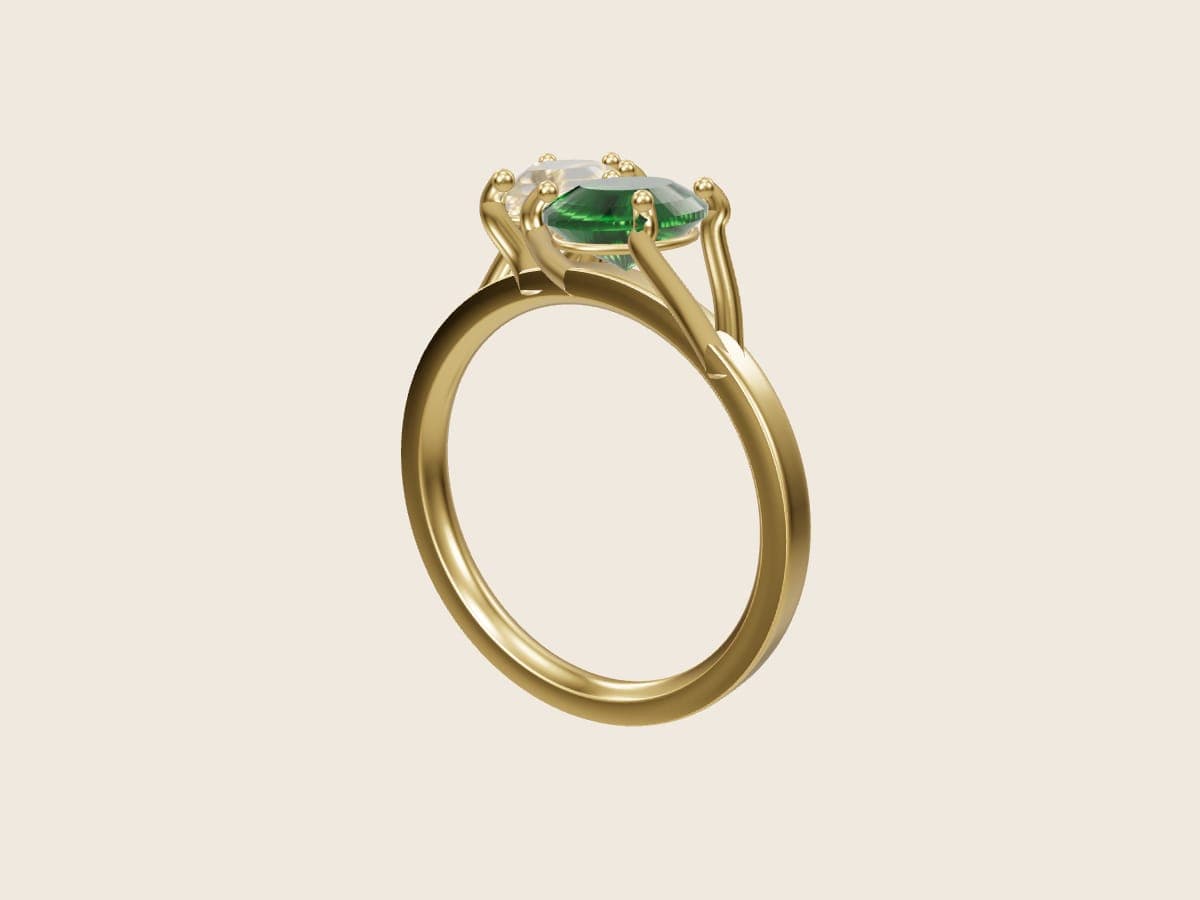
A toi et moi, French for "you and me", is a ring with two stones of equal standing, side by side or on a diagonal, each in its own setting. It can pair any two shapes and any two stones: a diamond and a sapphire, two birthstones, or a new stone beside one you inherited.
What it is
Each stone sits in its own head, with its own prongs or bezel, at the height its depth calls for. Side by side, the two stones sit next to each other across the finger. On a diagonal they are offset along the finger as well, so they meet at an angle and the ring reads as one flowing line.
The stones never touch. There is always a little metal and air between them, so each is held on its own and each can be cleaned and checked on its own. On a bypass shank, each stone can sit on the end of one arm.
Toi et moi
"You and me": two stones side by side or on a diagonal, each in its own prongs or bezel. Any two shapes, any two stones.
Why people love it
It tells a story of two: two people, two birthstones, or an old stone and a new one. Mixing shapes, a pear with an oval, an emerald cut with a round, gives a ring that feels personal without being loud.
From across the room it reads as one design; up close, as two.
- Two stones with a story: two birthstones, a diamond and a sapphire, or a new stone beside an heirloom one.
- Reads as one design from across the room and as two up close.
Trade-offs
Two stones side by side make a wider ring than a solitaire, so the band and the wedding band are planned around it. Sara can contour a wedding band to sit beside it.
Two heads means two sets of prongs to check now and then. A halo, cathedral shoulders and a three-stone layout are not combined with a toi et moi: each stone keeps its own prongs or bezel.
- Wider on the finger than a solitaire, so the band and the wedding band are planned with it.
- Two heads means two sets of prongs to check now and then.
Who it suits
Anyone who wants a ring with two meanings in it, or who loves color beside a diamond. A diagonal pair suits a longer finger and a slim band; a side-by-side pair suits someone who wants the stones to read as a matched set.
Sizes
The two stones are usually close in size, or one a little smaller, so neither looks like an accent. Pairs of 6 to 8 mm stones are common; much larger pairs sit wide on the hand. The Design Studio shows both stones' millimeters and approximate carats, each from its own shape and stone.
Diagonal pairs sit far enough apart along the finger and across it that their outlines clear each other; side-by-side pairs sit with a small gap across the finger. Sara confirms the final spacing in CAD.
What affects the cost
Two stones set the cost: their shapes, sizes and kinds, natural or lab-grown diamond or a colored gemstone. Then the metal and its weight, and the hand work of two heads. Sara quotes after a consultation.
Every custom piece is quoted after a consultation; there are no posted prices for custom work.
Care
Clean it in warm water with a drop of dish soap and a soft toothbrush, working gently between the two heads, rinse and dry with a lint-free cloth. Take it off for the gym and the garden. Pacific Jewel rings come back to Sara for a clean and an inspection whenever you like.
Questions
Can the two stones be different?
Yes. Any two shapes and any two stones the studio offers: a diamond with an emerald, two sapphires, a lab-grown diamond beside a natural one.
Do the stones touch?
No. Each stone sits in its own setting with a little space between them, so each is held, cleaned and checked on its own.
Side by side or diagonal?
Side by side reads as a matched pair across the finger. Diagonal offsets them along the finger too, so they meet at an angle: softer and more flowing.
Can I add a halo?
Not to a toi et moi: each stone keeps its own prongs or bezel, which is what lets the two shapes read clearly.