Learn · Settings
Asymmetric rings
An asymmetric ring is one that is not mirrored left to right: a stone turned at an angle, a head moved a little off center, a band whose two ends sweep past each other, or a band left open. Each is a real, made style, and each moves the ring away from the expected while keeping it easy to wear.
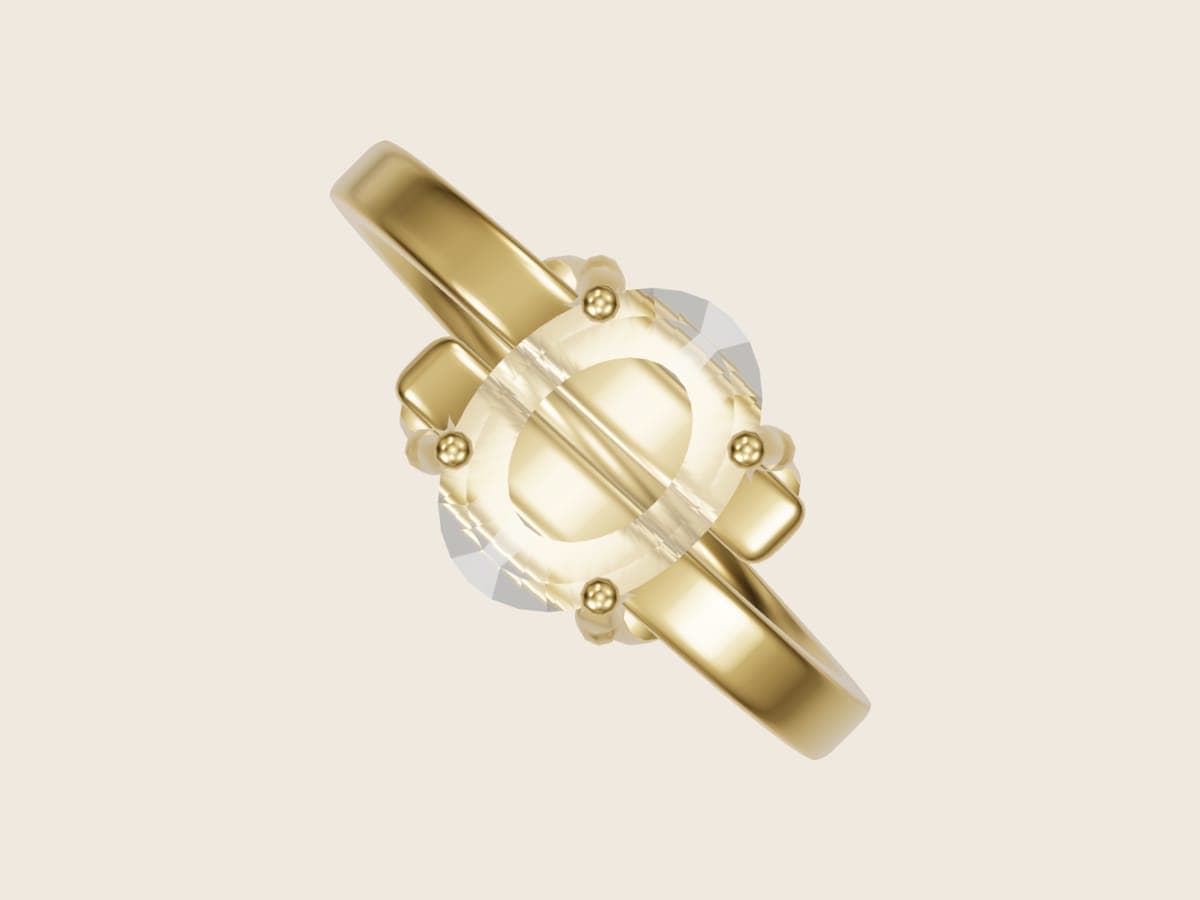
What it is
A tilted setting turns the stone on the band, neither along the finger nor across it. A princess cut turned 45° sits point to point, the kite set, with V-prongs guarding its corners. A round stone looks the same at any angle, so it is not tilted.
An offset setting moves the head a little round the band toward the thumb, so the stone sits off center, seated on the band where it lands.
A bypass shank opens the band into two arms that sweep past each other at the top, a little apart along the finger, cradling a stone between them or carrying one stone on each arm's end. An open band, for a wedding band, leaves a small gap at the top or turned to one side, its ends rounded.
Tilted setting
The stone turned a little on the band, neither along the finger nor across it. A princess turned 45° sits point to point: the kite set.
Offset setting
The head moved a little round the band toward the thumb, so the stone sits off-center.
Bypass shank
The band opens into two arms that sweep past each other at the top, cradling the stone between them, or carrying one stone on each arm’s end.
Open band
A band with a small gap, at the top or turned a little to one side, its ends rounded and closed.
Why people love it
A soft asymmetry makes a classic stone feel new without adding anything: the same diamond reads differently tilted, offset or held by a bypass. They look beautiful stacked, because a wedding band can tuck in beside them.
- Tilted setting: A quiet asymmetry: the same stone, read differently on the hand.
- Tilted setting: A kite-set princess protects its corners with V-prongs at the points.
- Offset setting: A soft, modern asymmetry that leaves room for a wedding band to tuck in.
- Offset setting: Beautiful in a stack.
- Bypass shank: Movement and asymmetry with a classic solitaire.
- Bypass shank: Each arm can carry a stone: a natural home for a toi et moi.
- Open band: Light and modern, and lovely stacked.
- Open band: Turned 30°, the gap reads as a soft asymmetry.
Trade-offs
Tilted: a tilted stone sits at an angle to a straight wedding band, so Sara often contours the band to it. A three-stone keeps its stones in a line, so it is not tilted.
Offset: an off-center stone turns more easily on a loose band, so a snug fit matters, and cathedral shoulders need the head centered.
Bypass: a straight wedding band meets the arms at an angle, and the arms take a little more polishing where they pass. A bypass is already off center, so it is not offset as well.
Open band: an open band flexes, so Sara confirms the size and the metal's thickness before it is made. Engraving goes inside, and there is no hidden stone at the top, where the gap is.
- Tilted setting: A tilted stone sits at an angle to a straight wedding band; Sara can contour the band to it.
- Offset setting: An off-center stone turns more easily on a loose band; a snug fit matters.
- Offset setting: Cathedral shoulders need the head centered.
- Bypass shank: A straight wedding band meets it at an angle; Sara can contour one to fit.
- Bypass shank: More metal to polish where the arms pass.
- Open band: An open band flexes, so Sara confirms the size and the metal’s thickness before it is made.
- Open band: Engraving goes inside, and there is no hidden stone at the top.
Who it suits
Anyone drawn to the modern and the handmade, and anyone who stacks. A tilted or offset stone suits someone who loves a solitaire but wants it to feel like theirs; a bypass suits a hand that likes movement; an open band suits someone who wants a light, airy wedding band.
Sizes
A tilt of 15°, 30° or 45° and an offset of about 10° or 20° round the band are the usual steps; the Design Studio offers those. On a bypass the arms pass with about 0.6 mm of air between them. An open band's gap is usually 2 to 8 mm.
None of these changes the stone's carats. The studio shows the metal weight for each, and Sara's CAD gives the final figures.
What affects the cost
The stone and the metal set most of the cost, as with any ring. A bypass shank or an open band uses a little more or less metal than a classic band, and asymmetric work takes a little more hand finishing. Sara quotes after a consultation.
Every custom piece is quoted after a consultation; there are no posted prices for custom work.
Care
Care is the same as for any fine ring: warm soapy water and a soft brush, and off for the gym and the garden. Where a bypass's arms pass, a soft brush keeps the gap clean. An open band should not be pulled wider or squeezed; bring it to Sara if the fit changes.
Questions
What is a kite set?
A princess cut turned 45° on the band, so it sits point to point, with V-prongs at its corners.
Which way does an offset setting move?
Toward the thumb, so the stone sits a little off center and a wedding band can tuck in beside it.
Can a bypass hold two stones?
Yes: a toi et moi on a bypass puts one stone on the end of each arm.
Will an open band stay its size?
An open band flexes a little. Sara confirms the size and the thickness of the metal so it holds its shape, and it should never be pulled wider.